Marriage of Rita Smith and Bill Smith
Killers of the Flower MoonRita Smith and Bill Smith’s marriage became a point where intimate violence, the search for the Osage murderers, and the transfer of Osage wealth converged. Bill had entered Rita’s family by marrying her sister Minnie, then married Rita only months after Minnie died of a mysterious wasting illness in 1918. Their marriage ended in the bombing of their home: Rita was killed, while Bill survived long enough to ask where she had been buried before dying four days after the blast. The deaths devastated the family and, because Bill outlived Rita, changed the route by which her wealth passed to heirs.
A Marriage Formed Through the Family’s Wealth
Bill Smith had been a horse thief before attaching himself to an Osage fortune through marriage. First he married Minnie; after her death, he married Rita, another of Mollie Burkhart’s sisters. The sequence placed him within a family whose members held valuable Osage headrights, although the available account does not establish that financial gain was his only reason for marrying either sister.
Rita was regarded by people close to her as keen-minded, but one person thought her judgment was impaired by what they described as a love that was truly blind. She repeatedly threatened to leave Bill, yet did not do so. The account does not say what kept her in the marriage. That unresolved contrast—between her intelligence, her threats, and her continued attachment—makes the relationship neither a simple portrait of ignorance nor evidence of consent to the treatment she endured.
Bill’s conduct toward Rita was sometimes violent. When he drank, he raised his hand to her. A servant recalled that after one quarrel Rita came out bruised. Bill explained his behavior to the servant in explicitly racist terms, treating violence against her as a way to manage Indigenous women. The abuse was not an isolated detail in an otherwise secure household: it stood alongside Rita’s threats to leave and the suspicions that gathered around Bill’s place in the family.
Suspicion, Investigation, and Fear
Mollie Burkhart wondered whether Bill had been responsible in some way for Minnie’s death. William K. Hale also made clear that he distrusted Bill, and a local attorney suspected that Bill was exploiting the institution of marriage for gain. These were suspicions, not proof that Bill had caused Minnie’s death. The distinction matters: Bill was both a man suspected by people around the family and, later, a target of a lethal attack whose perpetrators were not identified in these episodes.
After Anna Brown was murdered, Bill appeared to pursue the killer energetically. He shared information with private detectives and went with one of them to question a tailor thought to know something about the case. Instead, they encountered the familiar rumor that Rose Osage had killed Anna out of jealousy. Bill’s visible participation in the investigation complicated the image of him as merely an opportunist, but it did not resolve the earlier doubts about Minnie or establish that his efforts were sincere. The evidence holds those conflicting impressions together without settling them.
After Henry Roan’s death, Bill and Rita heard what they took to be intruders moving around their isolated house outside Fairfax. The noises came on more than one night: something rattled and probed around the perimeter, then disappeared. Bill told a friend that Rita was frightened, and he seemed to have lost the confidence with which he had once carried himself. Less than a month after Roan’s death, they left the house with most of their belongings behind and moved into a two-story home near the center of Fairfax, purchased from James Shoun, a close friend of Bill’s. They hoped neighbors’ watchdogs would alert them if anyone came near. Bill told a friend that perhaps the move would make the intruders leave them alone.
Their new home did not bring safety. A man came to the door claiming to have heard that Bill was selling farmland. Bill denied it and noticed that the stranger looked around the house as if assessing it. In early March, dogs in the neighborhood began dying, and Bill believed they had been poisoned. He told a friend that he did not expect to live much longer. In retrospect, the move, the suspected prowler, and the poisoned dogs form a sequence of warnings, but the evidence does not identify who was responsible for them or prove that they were all part of one plan.
The Bombing and Its Immediate Aftermath
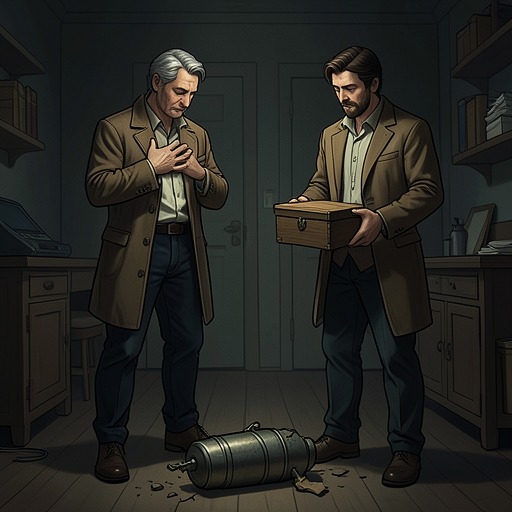
Just before three in the morning, an explosion demolished the Smiths’ house. The blast bent trees and signposts, broke windows, and sent people rushing toward the site with lanterns and guns. The house was reduced to charred sticks, twisted metal, and shredded furniture; even the Studebaker was destroyed. Bill and Rita had bought some of the wrecked furnishings only days earlier from the Big Hill Trading Company. The scale and placement of the damage made clear that a bomb had been planted beneath the house.
Bill was found alive beside the remains of his bed, his legs, back, and hands severely burned. Rita lay beside him in her nightgown. Her face was unmarked, but the back of her head had been crushed, and she was dead. Bill learned she was gone and cried out repeatedly that Rita was gone. He was badly injured and in delirium, sometimes saying that they had got Rita and now seemed to have got him as well. Their household had not been alone: Nettie, a young married woman with a child, could not be found, and the justice of the peace concluded she had been blown to pieces.
After nearly two days Bill regained consciousness. He asked about Rita and wanted to know where she was buried. David Shoun thought Bill might be about to reveal what he knew about the bombing, and tried to ask whether he had any idea who had done it. Bill disclosed nothing relevant. On March 14, four days after the bombing, he died. His death became part of the Osage Reign of Terror, while the hoped-for last statement that might have identified the perpetrators never came.
Inheritance and the Meaning of the Timing
The timing of the deaths had consequences beyond the immediate loss. William K. Hale’s investigation led Tom White to examine the family’s wills and the movement of headrights through successive deaths. Rita and Bill’s wills provided that if they died simultaneously, much of Rita’s headright would pass to her surviving sister, Mollie Burkhart. But Bill did not die with Rita: he survived her by several days and inherited much of her wealth. When he died, that money went to one of his relatives rather than following the simultaneous-death provision White had identified.
White saw the bombing’s timing as a miscalculation within a larger suspected design to concentrate the family’s headrights in Mollie, whose wealth was controlled by her husband, Ernest Burkhart, and thus potentially accessible to his uncle, William K. Hale. That was White’s reconstruction of the pattern, not proof in itself of who placed the bomb or what the perpetrators intended in this particular attack. The marriage therefore occupies two overlapping histories: an abusive relationship lived within the family, and an inheritance link whose legal consequences depended on which spouse died first.
The account’s record of the marriage is also framed by missing or compromised evidence. In the broader investigation, records of Anna Brown’s inquest had vanished, and investigators described a landscape where evidence was rarely preserved. The Smiths’ case, by contrast, left vivid traces of destruction but no confession from Bill and no identified bomber in these passages. That imbalance is central to the marriage’s narrative significance: personal suspicion, public terror, and the measurable transfer of wealth can be reconstructed, while the decisive question of responsibility remains unresolved.